Thursday, April 20, 2023
What to Do in Positano Capri Sorrento Italy
Sunday, April 16, 2023
Greve in Chianti
Greve in Chianti (the old name was Greve; in 1972 it was renamed Greve in Chianti after the inclusion of that area in the Chianti wine district) is a town and comune (municipality) in the Metropolitan City of Florence, Tuscany, Italy. It is located about 31 kilometres (19 mi) south of Florence and 42 kilometres (26 mi) north of Siena.
Sitting in the Val di Greve, it is named for the small, fast-flowing river that runs through it, is the principal town in the Chianti wine district which stretches south of Florence to just north of Siena. Until recently it has been a quiet, almost bucolic town because it was, and still is, well off the main roads.
Even in ancient days Greve was not isolated because it was well-connected by secondary roads to the Via Volterrana and via Francigena. Nowadays, it is connected to the A1 superstrada between Florence and Rome and the main road between Florence and Siena. The old road network ensured easy access to Florence and to other places such as Figline where its tradesmen and farmers found ready markets for their goods and produce.
History
The site of Greve and the surrounding territory has been long settled, probably well before the Etruscans and then the Romans dominated the area. Historical documents of the 11th century refer to an ancient monastic settlement on a nearby hill, which is now called the hill of San Francesco. Before the Franciscans established their monastery in the 15th century, an earlier monastery dedicated to Santo Savi had already been built, and also a small hospital. Larger scale settlement occurred in the 13th and 14th centuries.
Although an independent town for most of its history, Greve ultimately came under Florentine control and remained so until the Grand Duchy of Tuscany was absorbed into the unified Kingdom of Italy in 1861.
With the enlargement of the Chianti wine district in 1932, Greve suddenly found itself in a noble wine area. The Chianti region supports a variety of agricultural activities, most especially the growing of the grapes that go into the world-famous Chianti and "Super Tuscan" wines. Olive oil production is another staple of the local economy. Extra virgin Tuscan olive oil is highly prized for its delicate flavor, as opposed to the stronger, thicker olive oils of the south. Truffle harvesting is a distinguishing feature of local food production. Both black and white truffles are hunted in Chianti. The region is also noted for its meat. The Cinta Senese pig is unique to this region and produces pork of superior quality. Wild game is a common feature on local menus, including rabbit, pigeon, venison, and, especially, cinghiale (wild boar). Greve is home to one of Italy's oldest and most renowned butcher shops, the Macelleria Falorni.
Due largely to this intense agricultural activity, and the wine and food production industries that have been built on top of it, since early medieval times, Greve evolved as the principal market town at the center of an (increasingly) densely populated area with an abundance of villages, parish churches, villas and castles. The latter were built mostly by the rich merchants and noble classes of Florence who enjoyed the country life, and developed their estates to earn additional income and also to supply their in-town tables.
The town of Greve's busy quaintness and the lushness and diversity of the undulating landscape which surrounds it, have long attracted tourists and travelers. The current flow of tourism to the area and the purchase of homes by both Italians and foreigners is fully integrated with viniculture, wine-making and various related enterprises to form a highly integrated and highly productive local economy.
WINE CELLAR
Monday, April 3, 2023
My Favorite Beach in Positano
Positano
Terrazzo at La SCOGLIERA BEACH CLUB
I first spent a couple wonderful days at La Scogliera Beach Club way back in the Summer of 1985. I was a young man of just 23 back then, and getting a Chaise Lounge and hanging out at La Scogliera was like a dream come true. Like I had seen in movies as a kid, Agent 007 James Bond and the like swimming exclusive Mediterranean Beach, lounging at exclusive beach clubs with beautiful European Women, and living "The Good Life," and here, so was I. Yes it was a dream come true. Most young men my age would have opted for one of the free beaches, but not I. I would pay more to be among the beautiful people. Especially the gorgeous bikini clad girls. Or just half a bikini? Just the bottoms as the sun bathed going topless, I must say I enjoyed it all so very much. I had my chaise lounge, Campari & OJ, lovely music playing, the Sun, the Sand, the Beach, Beautiful Women, "yes, I was in 7th Heaven," to say the least, I felt like a King back then. Being in Positano, gorgeous girls, great Italian Food, Cocktails, gelato, properly pulled Espresso, the World's Best Pizza, the Casa Albertina, "what more could I want?" Not much I tell you. I was oh so happy those days in Positano, on the Amalfi Coast, Italy, for I was living my dream. My dream I saw on all those James Bond movies, growing up as a young boy in 1960s and 70s America.
We went to the Rivoli Theater in Rutherford, New Jersey. Yes I watched Bond, Sean Connery and Roger Moore, and I wanted to be just like them. Well, not a Secret Agent, but I wanted to travel the World, going to exotic locals with beautiful women, Deluxe Hotels, cars, Champagne & Caviar, as they say. Yes, movies like Summertime (Venice), William Holden in Hong Kong in The World of Suzy Wong, Humphrey Bogart in Casablanca, "that's what I wanted," and here I was at the exclusive beach club La Scogliera in Positano, on the Jet-Set Amalfi Coast. My dreams had come true. I savored it all, took it all in, and was appreciative at being there, in this one of the World's most beautiful spots of all.
I spent my day, just hanging out, either lounging on my chaise lounge, sipping my Campari, soaking in the Amalfi Coast Sun. I swam a lot. Yes, I'm not usually a beach person, except when I'm in places like; Capri, Positano, the Costa Brava, or French Riviera. Then I become one. A beach person, and so when I'm on Capri or Positano, I hang at the beach and spend quite a lot of time swimming the Mediterranean (Tyrrhenian Sea). I go in the water, and I'm swimming at least 15 to 20 minutes at a time, even up to 30 minutes before getting out of the water. Oh yes, I love swimming the waters of Capri (Da Luigi Beach Club) and Positano. I swim out and just float there at times, looking at the town that just seems to sprout and shoot up out of the sea, straight up to dizzying heights above. This scene is quite dramatic and awe inspiring, both on Capri and Positano, and I love it. Yes I love floating on my back and looking out at the beautiful scene before me, the seagulls are singing, and I can faintly hear the music at the club, and chitter-chatter of people on the beach. It all blends together for the most lovely sound. That special sound of the seashore, do you know what I mean?
Yes, back in 1985, as a young man, I paid more ($8) to be and the beach, and felt it was worth every penny to be there. These days, a chaise lounge can run you anywhere from 20 to 40 Euro for the day, depending upon the time you are there, the price varies. Now I would not pay 4o Euro a day, that's a bit much. I would however pay 25 Euro to have a private chaise at La Scogliera Beach Club, Positano. That's the price (25 Euro) I pay for a chaise lounge and towel at Da Luigi Beach Club on by the Faraglioni Rocks in Capri. Expensive? Yes, but worth every penny to treat yourself to a special treat, "don't you think?"
by Daniel Bellino ZwickeAt The BEACH
La SCOGLIERA
The Restaurant
La SCOGLIERA BEACH CLUB
POSITANO
View from La SCOGLIERA BEACH CLUB
The AMALFI COAST
ITALY
Looking For a HOTEL
TRIPADVISOR
For ALL YOU"RE TRAVEL NEEDS

Swimming at La SCOGLIERA
.
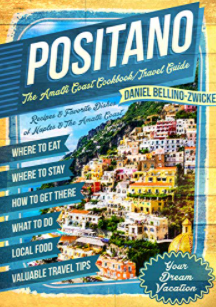
POSITANO The AMALFI COAST
COOKBOOK / TRAVEL GUIDE
EVERYTHING YOU NEED to KNOW
NAPLES - CAPRI - The AMALFI COAST
ITALY
.
Thursday, March 23, 2023
CAPRI
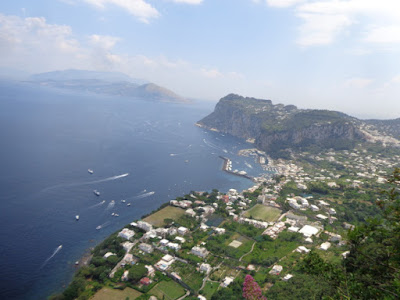
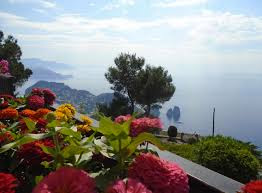
An island of rocky limestone, jagged coastline, and sandstone cliffs in the Gulf of Napoli, Capri has been a resort destination since the second century BC, when Roman emperors used it as a retreat and playground for what were rumored to be a wild slate of personal pleasures. Today, its natural wonders, medieval fortresses, rustic villas, posh shopping, and rugged coastline make it one of Italy’s most beloved travel destinations.
The center of social life on Capri is the popular Piazza Umberto I, “La Piazzetta,” which was once a fish market and now is one of the world’s most fashionable squares. It’s where locals and celebrities alike can be found sipping coffee or cocktails and people watching, surrounded by breathtaking views and architecture, including restored palaces, the Town Hall, and the famous Torre dell’Orologio, the clock tower that once was the bell tower of the Church of Santo Stefano.
In 1826, the re-discovery of the legendary Grotta Azzurra made Capri an even more desired destination. “The Blue Grotto” is a natural sea cavern and miracle of nature, where the water glows azure blue, illuminated by sunlight from an underwater cavity. Once feared to be the home of demons and spirits, it found new fame that drew artists, writers, and philosophers -- including Maxim Gorky, Henry James, Pablo Neruda, and Friederich Nietzsche – to the island, along with millions of tourists from around the world.
Dining on Capri can be as simple as a picnic of caprese sandwiches on the beach, a late-night pizza along Via Tommaso de Tommasi, or an unforgettable meal of authentic, artfully prepared delights at one of the island’s Michelin-starred destination restaurants. You can enjoy flawlessly prepared fish and shellfish in restaurants set in a lemon grove or on a cliff overlooking the sea – the options are as rich and delightful as the island itself.
“There is no spot in the world with such delightful possibilities of repose as this little isle.”
English writer and social critic Charles Dickens (1812-1870), on Capri
Home to Carthusia
It’s fitting that an island famed for its beauty would give birth to one of Italy’s most iconic beauty brands: Carthusia.
Legend maintains that the father prior of the Carthusian Monastery of St. Giacomo on Capri was surprised by an unexpected visit from Queen Joanna I of Anjou in 1380. He scrambled to pick the most beautiful flowers on the island to present her in a bouquet. After the bouquet stood in a vase for three days, the water had taken on a haunting and beautiful fragrance – a scent of wild carnations that became the first perfume of Capri.
Whether there’s truth to this legend or not, in 1681, the monastery began distilling local flowers and herbs to create essential oils and fragrance blends. Those same, centuries-old formulas were rediscovered in the 1940s, and Carthusia uses them today to continue the tradition of limited-production, finely crafted, hand-produced fragrances of magnificent quality.
Here are three of Mozzafiato’s Carthusia favorites to bring the magic of Capri into your heart and home:
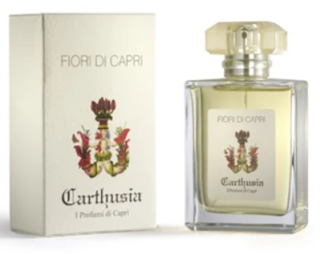
- The Fiori Di Capri scent is Carthusia's iconic bouquet of handpicked wild carnations and Capri's most precious floral essences. It's based on the legendary fragrance formula dating back to 1380. A frosted glass engraved with the logo Carthusia is perfect for perfuming every corner of your home.
Monday, January 16, 2023
NAPOLI Street Food
NAPOLI
ITALY